Wed-26-11-2024 11:30
profe: Mauro Cartabia
status:
tags:
Veamos algunos ejemplos donde usamos convergencia monótona
Supongo f : E → [ 0 , + ∞ ] f:E\to[0,+\infty] f : E → [ 0 , + ∞ ] E E E μ ( E ) < + ∞ \mu(E)<+\infty μ ( E ) < + ∞
f n ( x ) = m i n { f ( x ) , n } con f n integrables f_{n}(x)=min\{ f(x),n \}\quad \text{ con $f_{n}$ integrables } f n ( x ) = min { f ( x ) , n } con f n integrables f n ↗ f f_{n}\nearrow f f n ↗ f Si f ( x ) = ∞ f(x)=\infty f ( x ) = ∞ f n ( x ) = n f_{n}(x)=n f n ( x ) = n n ≠ ∞ n\neq \infty n = ∞ f ( x ) < ∞ , ∃ n 0 ∣ f n ( x ) = f ( x ) ∀ n ≥ n 0 f(x)<\infty,\:\exists\:n_{0}\:|\:f_{n}(x)=f(x)\quad\forall n\geq n_{0} f ( x ) < ∞ , ∃ n 0 ∣ f n ( x ) = f ( x ) ∀ n ≥ n 0
lim n → ∞ ∫ E f n d x = ∫ E f d x = ∫ E lim n → ∞ f n d x \underset{ n\to \infty }{ \lim } \int_{E}f_{n} \, dx=\int_{E} f \, dx=\int_{E}\underset{ n\to \infty }{ \lim } f_{n} \, dx n → ∞ lim ∫ E f n d x = ∫ E f d x = ∫ E n → ∞ lim f n d x Ahora con p > 0 , f : [ 0 , 1 ) → [ 0 , ∞ ] p> 0,f:[0,1)\to[0,\infty] p > 0 , f : [ 0 , 1 ) → [ 0 , ∞ ]
f ( x ) = { 1 x p x > 0 ∞ x = 0 f(x)=\begin{cases}
\frac{1}{x^{p} } & x> 0 \\
\infty & x=0
\end{cases} f ( x ) = { x p 1 ∞ x > 0 x = 0 f ( x ) ≥ n ⟺ 1 x p ≥ n ⟺ 1 n ≥ x p ⟺ 1 n 1 p ≥ x f(x)\geq n\iff \frac{1}{x^{p} }\geq n\iff \frac{1}{n}\geq x^{p} \iff \frac{1}{n^{\frac{1}{p}} }\geq x f ( x ) ≥ n ⟺ x p 1 ≥ n ⟺ n 1 ≥ x p ⟺ n p 1 1 ≥ x f n ( x ) = { n x ≤ 1 n 1 p 1 x p x > 1 n 1 p f_{n}(x)=\begin{cases}
n & x\leq \frac{1}{n^{\frac{1}{p}} } \\
\frac{1}{x^{p} } & x>\frac{1}{n^{\frac{1}{p}} }
\end{cases} f n ( x ) = ⎩ ⎨ ⎧ n x p 1 x ≤ n p 1 1 x > n p 1 1 ∫ E f n d x = ∫ [ 0 , 1 n 1 p ] n d x + ∫ 1 x 1 p d x = n . n − 1 p + { ln ( x ) ∣ n − 1 p 1 p = 1 x 1 − p 1 − p ∣ n − 1 p 1 p ≠ 1 \int _{E}f_{n} \, dx =\int_{\left[ 0,\frac{1}{n^{\frac{1}{p}} } \right]}n\,dx+\int \frac{1}{x^{\frac{1}{p}} } \, dx =n.n^{-\frac{1}{p}} +\begin{cases}
\ln(x)|_{_{n^{-\frac{1}{p}} }}^{^{1}} &p=1 \\
\frac{x^{1-p} }{1-p}|_{_{n^{-\frac{1}{p}} }}^{^{1}} & p\neq 1
\end{cases} ∫ E f n d x = ∫ [ 0 , n p 1 1 ] n d x + ∫ x p 1 1 d x = n . n − p 1 + ⎩ ⎨ ⎧ ln ( x ) ∣ n − p 1 1 1 − p x 1 − p ∣ n − p 1 1 p = 1 p = 1 = { 1 + ln ( n ) p = 1 n 1 − 1 p + 1 1 − p − ( n − 1 p ) 1 − p 1 − p p ≠ 1 = { 1 + ln ( n ) p = 1 1 1 − p + n 1 − 1 p ( 1 − n 1 − 1 p 1 − p ) p ≠ 1 =\begin{cases}
1+\ln(n) & p=1 \\
n^{1-\frac{1}{p}} +\frac{1}{1-p}-\frac{\left( n^{-\frac{1}{p}} \right)^{1-p}}{1-p} & p\neq 1
\end{cases}=\begin{cases}
1+\ln(n) & p=1 \\
\frac{1}{1-p}+n^{1-\frac{1}{p}}\left( 1-\frac{n^{1-\frac{1}{p}} }{1-p} \right) & p\neq 1
\end{cases} = ⎩ ⎨ ⎧ 1 + ln ( n ) n 1 − p 1 + 1 − p 1 − 1 − p ( n − p 1 ) 1 − p p = 1 p = 1 = ⎩ ⎨ ⎧ 1 + ln ( n ) 1 − p 1 + n 1 − p 1 ( 1 − 1 − p n 1 − p 1 ) p = 1 p = 1 = { 1 + ln ( n ) p = 1 1 1 − p + n 1 − 1 p ( 1 − 1 1 − p ) p ≠ 1 =\begin{cases}
1+\ln(n) & p=1 \\
\frac{1}{1-p}+n^{1-\frac{1}{p}} \left( 1-\frac{1}{1-p} \right) & p\neq 1
\end{cases} = { 1 + ln ( n ) 1 − p 1 + n 1 − p 1 ( 1 − 1 − p 1 ) p = 1 p = 1 ∫ [ 0 , 1 ] f d x = lim n → ∞ { 1 + ln ( n ) p = 1 1 1 − p + n 1 − 1 p ( 1 − n 1 − 1 p 1 − p ) p ≠ 1 \int _{[0,1]}f \, dx =\underset{ n\to \infty }{ \lim }\begin{cases}
1+\ln(n) & p=1 \\
\frac{1}{1-p}+n^{1-\frac{1}{p}}\left( 1-\frac{n^{1-\frac{1}{p}} }{1-p} \right) & p\neq 1
\end{cases} ∫ [ 0 , 1 ] f d x = n → ∞ lim ⎩ ⎨ ⎧ 1 + ln ( n ) 1 − p 1 + n 1 − p 1 ( 1 − 1 − p n 1 − p 1 ) p = 1 p = 1 = { ∞ p ≥ 1 1 1 − p p < 1 =\begin{cases}
\infty & p\geq 1 \\
\frac{1}{1-p} & p<1
\end{cases} = { ∞ 1 − p 1 p ≥ 1 p < 1 O b s : Obs: O b s : f f f ∀ p \forall p ∀ p f f f
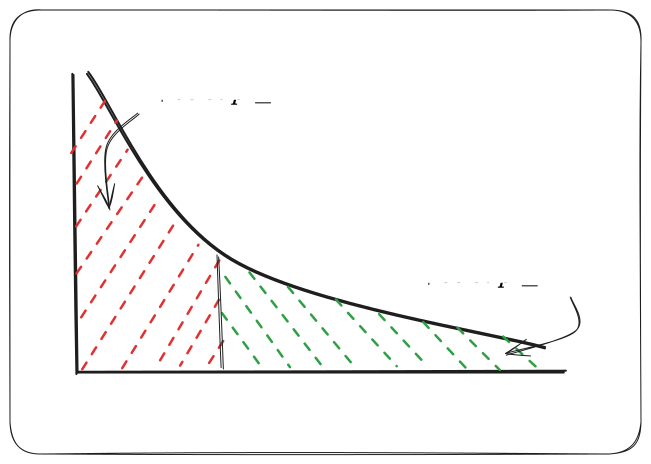
1 x p integrable ⋅ 1 x q integrable = 1 x p . q no integrable con p , q < 1 y p + q ≥ 1 \underset{ \text{integrable} }{ \frac{1}{x^{p} } }\cdot \underset{ \text{integrable} }{ \frac{1}{x^{q} } }=\underset{ \text{no integrable} }{ \frac{1}{x^{p.q} } }\quad \text{con }p,q<1\text{ y }p+q\geq 1 integrable x p 1 ⋅ integrable x q 1 = no integrable x p . q 1 con p , q < 1 y p + q ≥ 1 Ahora con p > 0 , f : [ 1 , ∞ ) → [ 0 , ∞ ] p> 0,f:[1,\infty)\to[0,\infty] p > 0 , f : [ 1 , ∞ ) → [ 0 , ∞ ] f ( x ) = 1 x p f(x)=\frac{1}{x^{p}} f ( x ) = x p 1
f n ( x ) = f ( x ) ⋅ χ [ 1 , n ] ( x ) = { 1 x p x ≤ n 0 x > n f_{n}(x)=f(x)\cdot \chi_{_{[1,_{n}]}}(x)=\begin{cases}
\frac{1}{x^{p} } & x\leq n \\
0 & x>n
\end{cases} f n ( x ) = f ( x ) ⋅ χ [ 1 , n ] ( x ) = { x p 1 0 x ≤ n x > n entonces me quedan integrable(no sé si la f f f f n ↗ f f_{n}\nearrow f f n ↗ f x ∃ n 0 ∣ x − 1 < n 0 ≤ x x \:\exists\:n_{0}\:|\:x-1<n_{0}\leq x x ∃ n 0 ∣ x − 1 < n 0 ≤ x f n ( x ) = f ( x ) ∀ n ≥ n 0 f_{n}(x)=f(x)\quad\forall n\geq n_{0} f n ( x ) = f ( x ) ∀ n ≥ n 0 f n ( x ) = 0 ∀ n < n 0 f_{n}(x)=0\quad\forall n<n_{0} f n ( x ) = 0 ∀ n < n 0
∫ [ 1 , ∞ ) f n ( x ) d x = ∫ [ 1 , n ] 1 x p d x = { ln ( x ) ∣ 1 n p = 1 x 1 − p 1 − p ∣ 1 n p ≠ 1 = { ln ( n ) p = 1 n 1 − p − 1 1 − p p ≠ 1 \int_{[1,\infty)} f_{n}(x) \, dx =\int_{[1,n]} \frac{1}{x^{p} } \, dx =\begin{cases}
\ln(x)|_{1}^{^{n} } & p=1 \\
\frac{x^{1-p} }{1-p}|_{1}^{^{n} } & p\neq 1
\end{cases}=\begin{cases}
\ln(n) & p=1 \\
\frac{n^{1-p} -1}{1-p} & p\neq 1
\end{cases} ∫ [ 1 , ∞ ) f n ( x ) d x = ∫ [ 1 , n ] x p 1 d x = { ln ( x ) ∣ 1 n 1 − p x 1 − p ∣ 1 n p = 1 p = 1 = { ln ( n ) 1 − p n 1 − p − 1 p = 1 p = 1 ∫ [ 1 , ∞ ] f n ( x ) d x = { ∞ p ≤ 1 1 p − 1 p > 1 \int_{[1,\infty]} f_{n}(x) \, dx=\begin{cases}
\infty & p\leq 1 \\
\frac{1}{p-1} & p>1
\end{cases} ∫ [ 1 , ∞ ] f n ( x ) d x = { ∞ p − 1 1 p ≤ 1 p > 1 f f f p > 1 p>1 p > 1 p > 0 p>0 p > 0 f : [ 0 , ∞ ] → [ 0 , ∞ ] f:[0,\infty]\to[0,\infty] f : [ 0 , ∞ ] → [ 0 , ∞ ]
f ( x ) = { 1 x p x > 0 o o x = 0 f(x)=\begin{cases}
\frac{1}{x^{p} } & x>0 \\
oo & x=0
\end{cases} f ( x ) = { x p 1 oo x > 0 x = 0 es una f f f p . p. p .
Citas y Comentarios