Thu-05-06-2025 20:25
profe: Dario Martin Aza
tags: Sucesiones y Series de funciones
Ejercicio 1
f n : R ⟶ R x ↦ x 1 + n 2 ⋅ x 2 \begin{array}{c}
f_{n}:\mathbb{R}&\longrightarrow& \mathbb{R} \\
x&\mapsto&\frac{x}{1+n^{2}\cdot x^{2}}
\end{array} f n : R x ⟶ ↦ R 1 + n 2 ⋅ x 2 x Analicemos la convergencia de f n f_{n} f n x ∈ R x \in \mathbb{R} x ∈ R f n ( x ) ⟶ 0 f_{n}(x)\longrightarrow0 f n ( x ) ⟶ 0 f n ⟶ 0 f_{n}\longrightarrow0 f n ⟶ 0
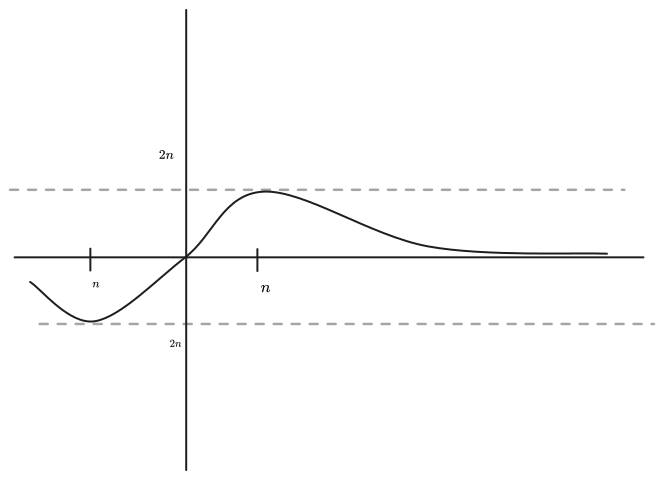
d ∞ ( f n , 0 ) = sup x ∈ R ∣ x 1 + n 2 ⋅ x 2 − 0 ∣ d_{\infty}(f_{n},0) =\underset{ x \in \mathbb{R} }{ \sup }\:\left| \frac{x}{1+n^{2}\cdot x^{2}} -0\right| d ∞ ( f n , 0 ) = x ∈ R sup 1 + n 2 ⋅ x 2 x − 0 Buscamos el supremo de ∣ f n ( x ) ∣ |f_{n}(x)| ∣ f n ( x ) ∣
f n ′ ( x ) = 1 + n 2 ⋅ x 2 − 2 n 2 ⋅ x 2 ( 1 + n 2 ⋅ x 2 ) 2 = 0 ⟺ ∣ x ∣ = 1 n f_{n}'(x)=\frac{1+n^{2}\cdot x^{2}-2n^{2}\cdot x^{2}}{(1+n^{2}\cdot x^{2})^{2}}=0\iff |x|=\frac{1}{n} f n ′ ( x ) = ( 1 + n 2 ⋅ x 2 ) 2 1 + n 2 ⋅ x 2 − 2 n 2 ⋅ x 2 = 0 ⟺ ∣ x ∣ = n 1 f n ( 1 n ) = 1 2 n f n ( − 1 n ) = − 1 2 n \begin{array}{c}
f_{n}\left( \frac{1}{n} \right)=\frac{1}{2n} \\
f_{n}\left(- \frac{1}{n} \right)=-\frac{1}{2n}
\end{array} f n ( n 1 ) = 2 n 1 f n ( − n 1 ) = − 2 n 1
m a x x ∈ R ∣ f n ( x ) ∣ = 1 2 n ⟶ 0 ⟹ f n ⇉ 0 \underset{ x \in \mathbb{R} }{ max }\:|f_{n}(x)|=\frac{1}{2n}\longrightarrow 0\implies f_{n}\rightrightarrows 0 x ∈ R ma x ∣ f n ( x ) ∣ = 2 n 1 ⟶ 0 ⟹ f n ⇉ 0 Ejercicio 2
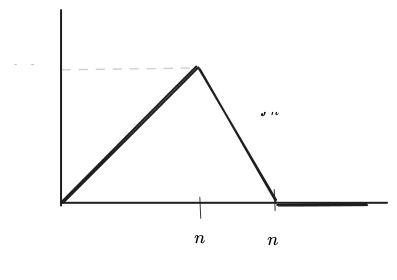
f n : [ 0 , 1 ] → R ∀ n ∈ N f_{n}:[0,1]\to \mathbb{R}\quad\forall n\in \mathbb{N} f n : [ 0 , 1 ] → R ∀ n ∈ N f n ( x ) = { n 2 ⋅ x 0 ≤ x ≤ 1 n − n 2 ( x − 2 n ) 1 n ≤ x ≤ 2 n 0 2 n ≤ x f_{n}(x)=\begin{cases}
n^{2}\cdot x & 0\leq x\leq \frac{1}{n} \\
-n^{2}\left( x-\frac{2}{n} \right) & \frac{1}{n}\leq x\leq \frac{2}{n} \\
0 & \frac{2}{n}\leq x
\end{cases} f n ( x ) = ⎩ ⎨ ⎧ n 2 ⋅ x − n 2 ( x − n 2 ) 0 0 ≤ x ≤ n 1 n 1 ≤ x ≤ n 2 n 2 ≤ x
Afirmo f n ⟶ 0 f_{n}\longrightarrow 0 f n ⟶ 0 x ∈ [ 0 , 1 ] , x \in[0,1], x ∈ [ 0 , 1 ] , f n ( x ) ⟶ 0 f_{n}(x)\longrightarrow 0 f n ( x ) ⟶ 0
Si x = 0 , x=0, x = 0 , f n ( x ) = 0 ∀ n ∈ N f_{n}(x)=0\quad\forall n\in \mathbb{N} f n ( x ) = 0 ∀ n ∈ N
Si x > 0 , ∃ n 0 ∈ N ∣ n ≥ n 0 ⟹ 1 2 n < x x>0,\:\exists\:n_{0}\in \mathbb{N}\bigm|n\geq n_{0}\implies \frac{1}{2n}<x x > 0 , ∃ n 0 ∈ N n ≥ n 0 ⟹ 2 n 1 < x
⟹ f n ( x ) = 0 ∀ n ≥ n 0 \implies f_{n}(x)=0\quad\forall n\geq n_{0} ⟹ f n ( x ) = 0 ∀ n ≥ n 0 ⟹ f n ( x ) ⟶ 0 \implies f_{n}(x)\longrightarrow 0 ⟹ f n ( x ) ⟶ 0 ⟹ f n ⟶ 0 \implies f_{n}\longrightarrow0 ⟹ f n ⟶ 0
¿ Será uniforme ?
d ∞ ( f n , 0 ) = m a x x ∈ [ 0 , 1 ] ∣ f n ( x ) ∣ = n ⟶ 0 d_{\infty}(f_{n},0) =\underset{ x \in[0,1] }{ max }\:|f_{n}(x)|=n\cancel{ \longrightarrow }0 d ∞ ( f n , 0 ) = x ∈ [ 0 , 1 ] ma x ∣ f n ( x ) ∣ = n ⟶ 0 No es uniforme, voy a dar este motivo:
∫ 0 1 f n ( x ) d x = 1 ∀ n ∈ N \int_{0}^{1} f_{n} (x) \, dx =1\quad \forall n\in \mathbb{N} ∫ 0 1 f n ( x ) d x = 1 ∀ n ∈ N pero
∫ 0 1 0 d x = 0 \int _{0}^{1} 0 \, dx =0 ∫ 0 1 0 d x = 0 Ejercicio 3
Sea X espacio m e ˊ trico, f n : X ⟶ R continuas ∀ n ∈ N , con f n ⇉ f , x n ⟶ x en X . Probar que f n ( x n ) ⟶ f ( x ) \begin{array}{l}
\text{Sea $X$ espacio métrico, $f_{n}:X\longrightarrow\mathbb{R}$ continuas $\forall n\in \mathbb{N},$ con $f_{n}\rightrightarrows f,x_{n}\longrightarrow x$ en $X.$ }\\
\text{Probar que $f_{n}(x_{n})\longrightarrow f(x)$ }
\end{array} Sea X espacio m e ˊ trico, f n : X ⟶ R continuas ∀ n ∈ N , con f n ⇉ f , x n ⟶ x en X . Probar que f n ( x n ) ⟶ f ( x ) S o l : Sol: S o l :
∣ f ( x ) − f n ( x n ) ∣ = ∣ f ( x ) − f ( x n ) + f ( x n ) − f n ( x n ) ∣ ≤ ∣ f ( x ) − f ( x n ) ∣ + ∣ f ( x n ) − f n ( x n ) ∣ |f(x)-f_{n}(x_{n})|=|f(x)-f(x_{n})+f(x_{n})-f_{n}(x_{n})|\leq |f(x)-f(x_{n})|+|f(x_{n})-f_{n}(x_{n})| ∣ f ( x ) − f n ( x n ) ∣ = ∣ f ( x ) − f ( x n ) + f ( x n ) − f n ( x n ) ∣ ≤ ∣ f ( x ) − f ( x n ) ∣ + ∣ f ( x n ) − f n ( x n ) ∣ Como f n ⇉ f , f_{n}\rightrightarrows f, f n ⇉ f , f f f f f f ∃ n 1 ∈ N ∣ n ≥ n 0 ⟹ ∣ f ( x ) − f ( x n ) ∣ < E 2 \:\exists\:n_{1}\in \mathbb{N}\bigm|n\geq n_{0}\implies |f(x)-f(x_{n})|<\frac{\mathcal{E}}{2} ∃ n 1 ∈ N n ≥ n 0 ⟹ ∣ f ( x ) − f ( x n ) ∣ < 2 E x n ⟶ x ⟹ f ( x n ) ⟶ f ( x ) x_{n}\longrightarrow x\implies f(x_{n})\longrightarrow f(x) x n ⟶ x ⟹ f ( x n ) ⟶ f ( x )
Como f n ⇉ f f_{n}\rightrightarrows f f n ⇉ f ∃ n 2 ∈ N ∣ n ≥ n 2 ⟹ ∣ f n ( y ) − f ( y ) ∣ < E 2 ∀ y ∈ X . \:\exists\:n_{2}\in \mathbb{N}\bigm|n\geq n_{2}\implies |f_{n}(y)-f(y)|<\frac{\mathcal{E}}{2}\quad\forall y \in X. ∃ n 2 ∈ N n ≥ n 2 ⟹ ∣ f n ( y ) − f ( y ) ∣ < 2 E ∀ y ∈ X . x n . x_{n}. x n .
⟹ ∣ f ( x ) − f n ( x n ) ∣ < E 2 + E 2 = E ∀ n ≥ n 0 = m a x { n 1 , n 2 } \implies |f(x)-f_{n}(x_{n})|<\frac{\mathcal{E}}{2}+\frac{\mathcal{E}}{2}=\mathcal{E}\quad\forall n\geq n_{0}=max\{ n_{1},n_{2} \} ⟹ ∣ f ( x ) − f n ( x n ) ∣ < 2 E + 2 E = E ∀ n ≥ n 0 = ma x { n 1 , n 2 } Otro argumento:
( 1 n ) ⟶ 0 \left( \frac{1}{n} \right)\longrightarrow0 ( n 1 ) ⟶ 0 f n ( 1 n ) = n ⟶ f ( 0 ) = 0 f_{n}\left( \frac{1}{n} \right)=n\cancel{ \longrightarrow }f(0)=0 f n ( n 1 ) = n ⟶ f ( 0 ) = 0
Ejercicio 4
Para cada n ∈ N n\in \mathbb{N} n ∈ N
f n ( x ) = n ⋅ x e n ⋅ x f_{n}(x)=\frac{n\cdot x}{e^{n\cdot x} } f n ( x ) = e n ⋅ x n ⋅ x
f n : [ 0 , + ∞ ) → R f_{n}:[0,+\infty)\to \mathbb{R} f n : [ 0 , + ∞ ) → R f = 0 f=0 f = 0 f n : [ 1 , + ∞ ) → R f_{n}:[1,+\infty)\to \mathbb{R} f n : [ 1 , + ∞ ) → R f = 0 f=0 f = 0 f n : [ 0 , + ∞ ) → R f_{n}:[0,+\infty)\to \mathbb{R} f n : [ 0 , + ∞ ) → R f = 0 f=0 f = 0
Llamo, para cada x > 0 x>0 x > 0 g x : R → R g_{x}:\mathbb{R}\to \mathbb{R} g x : R → R
g x ( y ) = x ⋅ y e x y g_{x}(y)=\frac{x\cdot y}{e^{xy} } g x ( y ) = e x y x ⋅ y Queremos ver que ( n ⋅ x e n x ) ⟶ 0 \displaystyle\left( \frac{n\cdot x}{e^{nx}} \right)\longrightarrow 0 ( e n x n ⋅ x ) ⟶ 0
lim y → ∞ x ⋅ y e x y = L ′ H lim y → ∞ x e x y ⋅ x = 0 \underset{ y\to \infty }{ \lim } \frac{x\cdot y}{e^{xy} }\overset{L'H }{ = }\underset{ y\to \infty }{ \lim } \frac{x}{e^{xy} \cdot x}=0 y → ∞ lim e x y x ⋅ y = L ′ H y → ∞ lim e x y ⋅ x x = 0 pues x > 0. x>0. x > 0.
Otra forma es usar un criterio de convergencia.
con x = 0 , x=0, x = 0 , f n ( 0 ) = 0 ⟶ 0 f_{n}(0)=0\longrightarrow 0 f n ( 0 ) = 0 ⟶ 0
⟹ f n ⟶ f \implies f_{n}\longrightarrow f ⟹ f n ⟶ f
c) Considero x n = 1 n ⟶ 0 x_{n}=\frac{1}{n}\longrightarrow 0 x n = n 1 ⟶ 0 f n ( 1 n ) = 1 e ⟶ 0 ⟹ f n ⇉ f f_{n}\left( \frac{1}{n} \right)=\frac{1}{e}\cancel{ \longrightarrow }0\implies f_{n}\cancel{ \rightrightarrows } f f n ( n 1 ) = e 1 ⟶ 0 ⟹ f n ⇉ f
b) TAREA
O b s : Obs: O b s : f n f_{n} f n f . f. f . ∣ f n ( x ) ∣ ≤ a n , a n ⟶ 0 ⟹ f n ⇉ 0 |f_{n}(x)|\leq a_{n},\quad a_{n}\longrightarrow 0\implies f_{n}\rightrightarrows 0 ∣ f n ( x ) ∣ ≤ a n , a n ⟶ 0 ⟹ f n ⇉ 0
Ejercicio 5
Sea X X X f n : X → R , f : X → R f_{n}:X\to \mathbb{R},f:X\to \mathbb{R} f n : X → R , f : X → R f n , f f_{n},f f n , f f n → f f_{n}\to f f n → f f 1 ( x ) ≤ f 2 ( x ) ≤ ⋯ ≤ f n ( x ) ∀ x ∈ X f_{1}(x)\leq f_{2}(x)\leq\dots\leq f_{n}(x)\quad\forall x \in X f 1 ( x ) ≤ f 2 ( x ) ≤ ⋯ ≤ f n ( x ) ∀ x ∈ X f n ↗ f f_{n}\nearrow f f n ↗ f
⟹ f n ⇉ f \implies f_{n}\rightrightarrows f ⟹ f n ⇉ f S o l : Sol: S o l : E > 0 , \mathcal{E}>0, E > 0 , ∃ n 0 ∈ N ∣ n ≥ n 0 ⟹ ∣ f n ( x ) − f ( x ) ∣ = f ( x ) − f n ( x ) < E ∀ n ≥ n 0 , ∀ x ∈ X \:\exists\:n_{0}\in \mathbb{N}\bigm|n\geq n_{0}\implies \underset{ =f(x)-f_{n}(x) }{ |f_{n}(x)-f(x)| }<\mathcal{E}\quad\forall n\geq n_{0},\forall x \in X ∃ n 0 ∈ N n ≥ n 0 ⟹ = f ( x ) − f n ( x ) ∣ f n ( x ) − f ( x ) ∣ < E ∀ n ≥ n 0 , ∀ x ∈ X U n = { x ∈ X : f ( x ) − f n ( x ) < E } U_{n}=\{ x \in X:f(x)-f_{n}(x)<\mathcal{E} \} U n = { x ∈ X : f ( x ) − f n ( x ) < E } ∃ n 0 ∈ N ∣ n ≥ n 0 ⟹ U n = X \:\exists\:n_{0}\in \mathbb{N}\bigm|n\geq n_{0}\implies U_{n}=X ∃ n 0 ∈ N n ≥ n 0 ⟹ U n = X
f − f 1 ≥ f − f 2 ≥ … f-f_{1}\geq f-f_{2}\geq \dots f − f 1 ≥ f − f 2 ≥ … ⟹ U 1 ⊆ U 2 ⊆ ⋯ ⊆ U n ⊆ U n + 1 ⊆ ⋯ ⊆ X \implies U_{1}\subseteq U_{2}\subseteq\dots \subseteq U_{n}\subseteq U_{n+1}\subseteq\dots \subseteq X ⟹ U 1 ⊆ U 2 ⊆ ⋯ ⊆ U n ⊆ U n + 1 ⊆ ⋯ ⊆ X Luego U n = ( f − f n ) − 1 ( ( − ∞ , E ) ) U_{n}=(f-f_{n})^{-1}((-\infty,\mathcal{E})) U n = ( f − f n ) − 1 (( − ∞ , E )) f − f n f-f_{n} f − f n
Falta decir que por convergencia puntual U n U_{n} U n X . X. X .
Citas y Comentarios